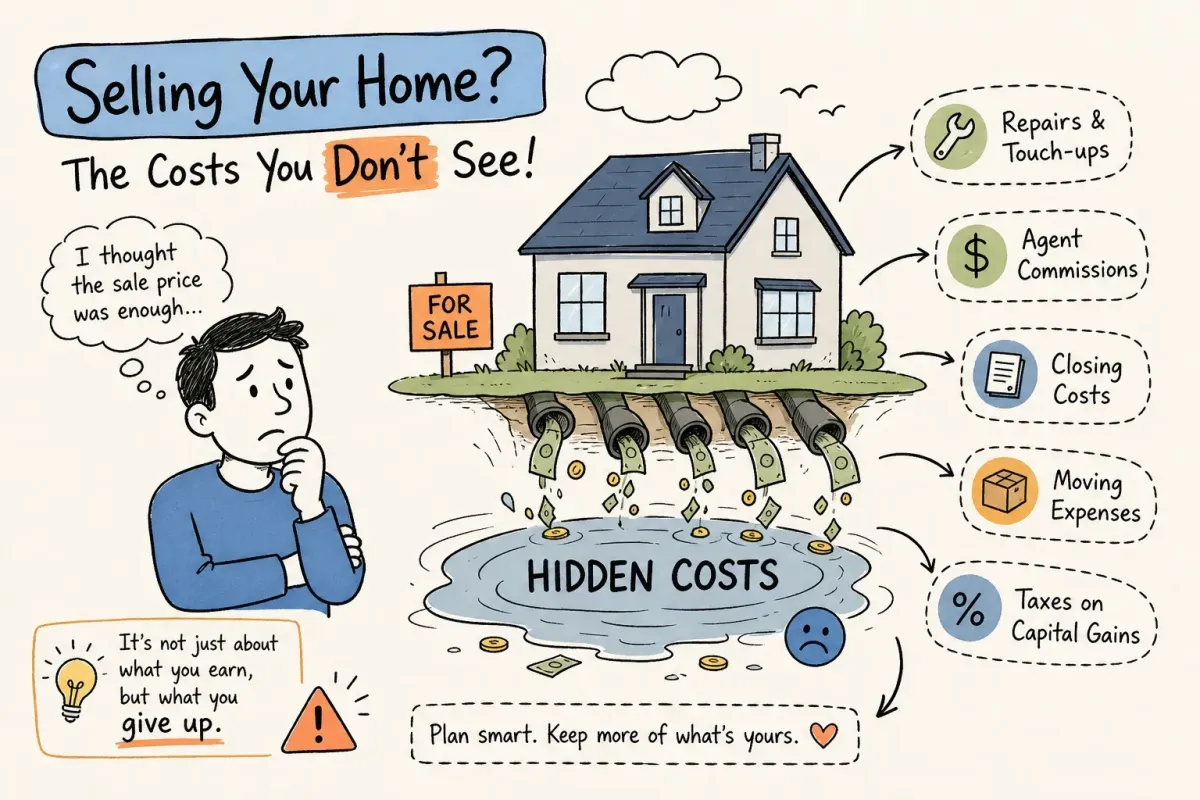
Hidden Costs of Selling Your Home: Complete Breakdown
When sellers do the math after closing, many are surprised to find that the total costs of selling your home stack up across six or seven separate categories, and by the time you reach the settlement table, those expenses can quietly consume 8, 10% of your sale price before a single dollar lands in your account.
This breakdown covers every major fee sellers typically face: agent commissions, title and escrow charges, transfer taxes, pre-sale repairs, staging, and your actual tax exposure. At the end, you'll find a realistic net-proceeds example built around a $500,000 sale so you can see exactly how the numbers play out in practice.
One of the first things a good local agent does before you list is hand you a seller net sheet, a one-page document that lines up all these costs against your expected sale price and shows you what you'll actually walk away with. A good local agent, like Annette at NewDay Real Estate Solutions, does this as part of a free pre-listing consultation for Snohomish County sellers. Knowing your real number up front changes how you approach everything from pricing to timing.
What real estate commissions actually cost you
Agent commissions are the single largest selling expense in any home sale, and the number is bigger than most sellers expect. Total commission typically runs 5, 6% of the sale price, split between the listing agent and the buyer's agent at roughly 2.5, 3% each. On a $500,000 home, that's $25,000, $30,000 in commissions alone before anything else hits the settlement statement.
It's worth understanding what that listing-agent fee actually covers. Professional photography, MLS access, strategic pricing analysis, marketing across multiple platforms, offer negotiation, and full transaction coordination from contract to closing all fall under that commission. When a well-marketed home sells for $15,000 more than a comparable one that was underpriced or poorly presented, the commission pays for itself many times over.
Rates are negotiable, and some agents offer reduced fees on higher-priced homes or for repeat clients. The cheapest commission doesn't always produce the best net proceeds, though. Shaving 0.5% off the listing fee while leaving money on the table during pricing or negotiation is a poor trade. Focus on total net proceeds, not just the commission line.
Post-NAR settlement changes that took effect in 2024 also shifted how buyer-agent compensation works. Sellers are no longer automatically responsible for both sides, but many still choose to offer buyer-agent compensation as a way to attract more buyers to the table. Your agent should walk you through the current norms in your local market before you decide.
Closing costs sellers are on the hook for
Beyond commissions, sellers in most markets pay a set of closing-side fees that routinely catch people off guard because they're buried in the fine print of the settlement statement. In Washington state, these seller expenses tend to run higher than the national average, largely because of the real estate excise tax.
Title and escrow fees
Title insurance and escrow fees are standard seller expenses. In Snohomish County, it's customary for the seller to provide the buyer's owner's title insurance policy, which typically runs 0.3, 0.6% of the sale price, or roughly $1,200, $2,400 on a $400,000 sale. Escrow and settlement fees add another $500, $2,000, sometimes split with the buyer depending on what's negotiated in the purchase agreement.
Washington's real estate excise tax (REET)
Washington's REET is worth breaking out separately. The state uses a graduated rate structure: 1.10% on the first $525,000 of the sale price, 1.28% on the portion between $525,000 and $1,525,000, and higher rates above that. On a $500,000 sale, you're looking at approximately $5,500 in state REET alone, plus applicable local REET from your city or county, which typically adds another 0.25, 0.50%. This is a significant cost that sellers in Texas or Indiana would never encounter, so don't rely on national cost estimates when you're selling in the Pacific Northwest.
Prorations, HOA fees, and seller credits
Property taxes are prorated to the closing date, which can mean a debit of several thousand dollars depending on when you close and your annual tax bill. HOA resale packages and transfer fees commonly run $100, $500. Seller-paid buyer closing-cost credits, when negotiated as part of offer acceptance, can add another 0, 3% of the sale price directly off your proceeds.
Pre-listing expenses: repairs, staging, and inspections
This is the category sellers most consistently underestimate, partly because the costs spread out over weeks and feel incremental until you add them up. Budget 1, 3% of your expected sale price for pre-listing work. On a $400,000 home, that's $4,000, $12,000 before you've accepted a single offer.
Minor repairs with strong visual impact are almost always worth doing: fresh interior paint, updated light fixtures, patched drywall, and cleaned-up landscaping all return more than they cost in both offer price and time on market. Significant deferred maintenance items, roofing, HVAC, or foundation issues, are trickier. If buyers find them during inspection, you'll face rushed price concessions negotiated under pressure. Addressing them proactively, or at least pricing them in transparently, keeps you in control of the conversation.
Avoid major renovation projects unless your agent can point to clear comparable evidence that the return justifies the spend. Professional staging in the Seattle and Snohomish County market currently runs $3,000, $6,000 for a typical vacant home, with partial or occupied-home staging starting around $800, $2,500. Staged homes sell faster and tend to generate stronger offers, and the cost is usually recovered in the final sale price. At minimum, budget for a professional deep clean and curb appeal work, which runs $500, $2,000 depending on the property's condition.
A pre-listing inspection is one of the most underused tools in a seller's toolkit. At $300, $600, it gives you a complete picture of what buyers will discover during their own inspection, eliminating last-minute surprises that kill deals or force frantic price reductions. Sellers who address known issues before listing negotiate from a position of confidence instead of scrambling at the worst possible moment.
Taxes on your sale: what actually applies
Federal capital gains tax is the question sellers ask about most often, and for most primary-residence sellers, it turns out to be much less of an issue than expected. The IRS allows single filers to exclude up to $250,000 of gain from the sale of a primary residence, and married couples filing jointly can exclude up to $500,000. To qualify, you must have owned and lived in the home as your primary residence for at least two of the five years before the sale date.
Here's a practical example: you buy a home for $300,000, sell it for $620,000, and pay $35,000 in selling costs. Your taxable gain is $285,000. A single seller excludes $250,000 and may owe federal capital gains tax only on the remaining $35,000. A married couple filing jointly excludes the full $285,000 gain entirely. For most Snohomish County homeowners selling a primary residence, the exclusion covers the gain completely or limits the tax exposure to a manageable amount.
The picture changes if you've rented the home, used it as an investment property, or have depreciation to recapture. In those situations, the exclusion may be limited or unavailable, and long-term capital gains rates of 0%, 15%, or 20% apply depending on your income bracket. A 3.8% net investment income tax may also apply. If your situation involves a rental conversion, a short ownership period, or a very large gain, talk to a CPA before you list. Tax planning done before the sale is always less expensive than a tax bill discovered after it.
FSBO vs. using an agent: how the costs compare
Some sellers consider going the for-sale-by-owner (FSBO) route to avoid the listing-agent commission, typically saving 2.5, 3% of the sale price. On a $500,000 home, that's a potential $12,500, $15,000 in savings, on paper. In practice, FSBO homes statistically sell for less than agent-represented homes, often enough to offset the commission savings entirely. You also take on all the work: pricing research, marketing, showings, disclosure compliance, offer review, and transaction coordination. Errors in any of those areas can cost far more than a commission. Most sellers find that a skilled agent more than earns their fee through stronger pricing, better negotiation, and a smoother close. If you're weighing the FSBO path, run both net-proceeds scenarios with real numbers before you decide.
What your net proceeds actually look like: a real example
Percentages only go so far, here's what the numbers look like on an actual $500,000 sale in Snohomish County.
Sale price: $500,000
Agent commissions (5.5%): -$27,500
Owner's title insurance and escrow fees: -$3,000
Washington state REET plus local REET (estimated): -$7,000
Prorated property taxes: -$2,000
Pre-listing repairs and staging: -$6,000
HOA transfer and document fees: -$400
Recording and administrative fees: -$200
Estimated proceeds after selling costs: approximately $453,900
Subtract your remaining mortgage balance from that figure and you have your true net cash from the sale. These are estimates, not guarantees. The actual numbers shift based on your home's condition, your local tax rates, what you negotiate with the buyer, and your payoff balance. But this range gives you a realistic starting point so you're not caught off guard at closing.
A seller net sheet is the formal version of this calculation, prepared by your agent before you list. It's a one-page estimate showing every expected cost and your projected net at a given sale price, updated as conditions change. Ask for one before you sign a listing agreement, not after. It's the most useful document in your pre-listing toolkit, and any experienced agent should produce it without hesitation.
Know your numbers before you list
The costs of selling your home are predictable once you know where to look. Agent commissions carry the most weight, but title fees, Washington's real estate excise tax, pre-sale repairs, prorated property taxes, and staging all contribute to a total that deserves careful attention before you commit to a list price or a timeline.
The sellers who navigate this process most confidently are the ones who ran the numbers first. They knew their likely net proceeds, priced strategically based on real market data, and made deliberate choices about where to spend on preparation and where to hold back. They didn't discover a $15,000 surprise on the settlement statement three days before closing.
If you're thinking about selling in Snohomish County and want a clear-eyed look at what you'll actually net before you commit to anything, Annette at NewDay Real Estate Solutions offers a free seller consultation. She'll walk you through a customized seller net sheet based on your specific home, your neighborhood, and current market conditions in Everett, Lake Stevens, Snohomish, and surrounding communities. Understanding all the costs when selling your home starts with one conversation. Reach out to NewDay Real Estate Solutions to book your free consultation and get your real number before you list.
Annette Stoddard
NewDay Real Estate Solutions
Real Estate Agent | Snohomish County, Washington
+1 425-330-9794
