How Much Does It Cost to Buy a Home in Lynnwood, WA in 2026?st
If you're thinking about buying a home in Lynnwood, Washington, one of your first questions is probably:
How much is this actually going to cost me?
The simple answer is that many Lynnwood buyers should expect home prices in the $700,000s, but that number alone doesn't tell you what you'll actually spend.
Your cost depends on the type of property, location, condition, size, financing, down payment, HOA dues when applicable, property taxes, insurance, closing costs, and how competitive the particular home is.
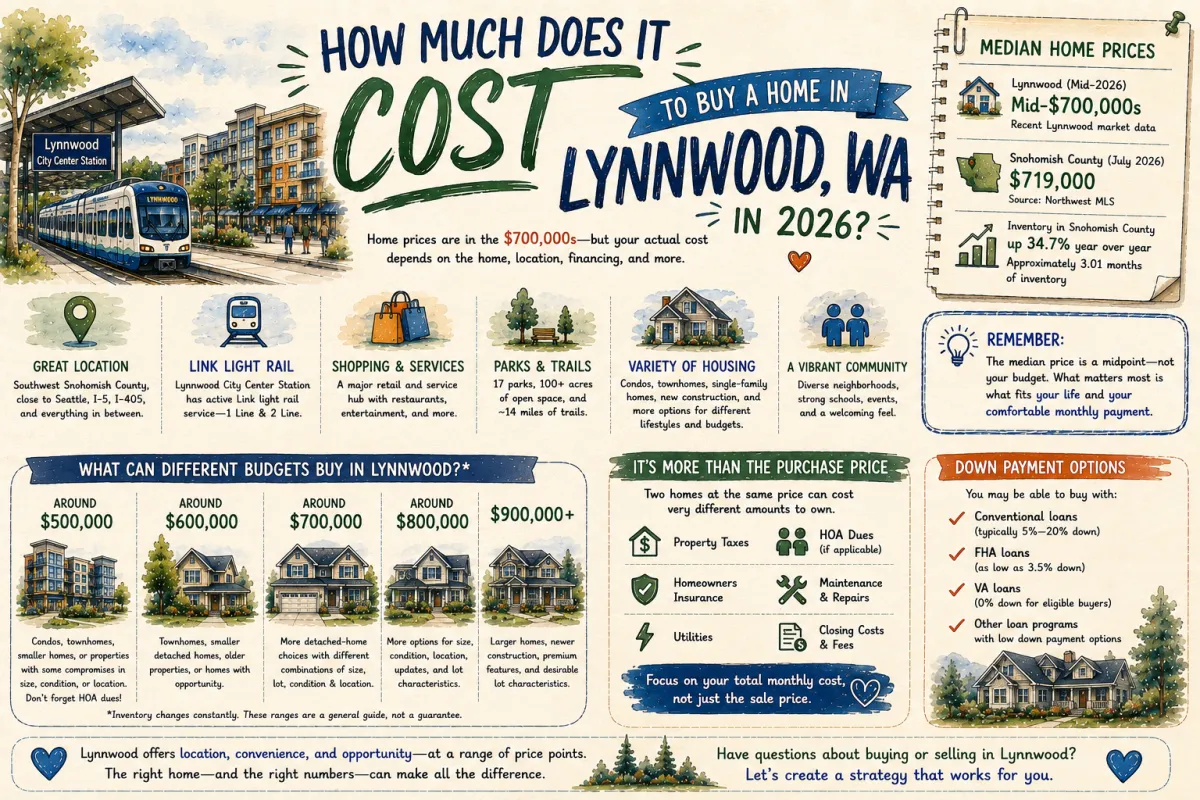
Recent Lynnwood market data puts the city's median sale price around the mid-$700,000 range, while the Snohomish County median sales price for residential homes and condominiums was $719,000 in July 2026.
But a median isn't your budget.
I'm Annette Stoddard, a real estate agent with NewDay Real Estate Solutions serving buyers and sellers in Lynnwood and throughout Snohomish County, Washington.
If you're considering buying in Lynnwood—or selling a Lynnwood home and wondering what today's buyers are dealing with—here's how I'd look at the numbers.
What Is the Median Home Price in Lynnwood, WA?
Recent Lynnwood market data has placed the median sale price around the mid-$700,000 range.
That gives us a useful starting point.
But don't interpret it as:
"I need $750,000 to buy in Lynnwood."
And don't interpret it as:
"Every Lynnwood house is worth about $750,000."
Neither is true.
A median simply tells us the midpoint of the homes included in that particular dataset and reporting period.
Your actual options can look very different depending on whether you're considering:
A condo
A townhome
A smaller detached house
An established single-family home
A larger home
Newer construction
A property needing improvements
A home with a larger lot
That's why I prefer to search from your comfortable payment and property needs instead of one citywide number.
How Does Lynnwood Compare With Snohomish County?
For broader context, Northwest Multiple Listing Service reported a $719,000 median sales price for Snohomish County in July 2026 for residential homes and condominiums.
Snohomish County inventory was also up 34.7% year over year, with approximately 3.01 months of inventory.
That second number matters.
More inventory means buyers generally have more homes to consider than they did when supply was extremely limited.
But 3.01 months of inventory is still below the four-to-six-month range commonly associated with a balanced market.
So I wouldn't describe this as a market where every buyer automatically has the upper hand.
It's more nuanced than that.
Some properties may offer negotiation opportunities.
Other desirable homes may still attract significant attention.
What Can Different Budgets Buy in Lynnwood?
This is a much better question than simply asking for the median.
Actual inventory changes constantly, so these aren't promises that a certain type of property will always be available at a specific price.
Think of them as a framework for building your search.
Around $500,000
Depending on current inventory, buyers around this level may be looking more heavily at condos, townhomes, smaller properties, or homes with compromises involving size, condition, or location.
The exact choices can change quickly.
If you're considering a condo or townhome, remember to include HOA dues and association considerations in your budget.
Around $600,000
As the budget increases, additional housing options may become available depending on inventory.
You might encounter townhomes, smaller detached homes, older properties, or homes where condition and location create an opportunity.
Don't assume a lower-priced detached home is automatically the better deal.
Understand why it's priced where it is.
Around $700,000
This range begins moving closer to the broader Lynnwood market.
Depending on inventory, buyers may see more detached-home choices and different combinations of size, condition, lot, and location.
This is where comparing properties becomes especially important.
Two homes with similar prices can have very different long-term ownership costs.
Around $800,000
A higher budget can potentially open more choices involving size, condition, location, updates, and housing type.
But don't let a larger approval automatically become a larger purchase.
If the $725,000 home fits your life better than the $800,000 home, that's the one we should evaluate.
$900,000 and Above
At higher price points, buyers may encounter larger homes, newer properties, upgraded homes, different lot characteristics, or other premium features.
But price alone doesn't determine quality.
Even expensive homes need appropriate inspections, due diligence, and market analysis.
Recent Lynnwood Sales Show Why the Median Doesn't Tell the Whole Story
One reason I don't want buyers fixating on a single median is that recent Lynnwood-area transactions span a wide range.
Recent sales have included properties around the $500,000s and $600,000s, while others have sold around $850,000, $1 million, and above.
Property types, locations, sizes, and conditions differ.
That's the point.
There's no single "Lynnwood house."
When we talk about your budget, we need to define what you're actually trying to buy.
Purchase Price Isn't the Same as Monthly Cost
This is one of the most important concepts for buyers.
Suppose two homes both cost $700,000.
They don't necessarily cost the same amount to own.
One might have an HOA.
One may have different insurance considerations.
One may require significant maintenance.
One may need a roof soon.
One may have been extensively updated.
Your actual housing budget should consider more than the sale price.
How Much Down Payment Do You Need?
A common misconception is that you always need 20% down to buy a home.
That's not necessarily true.
Different loan programs can have different down-payment requirements.
Depending on your qualifications and the property, there may be conventional, FHA, VA, or other financing possibilities.
Some buyers may also qualify for down-payment assistance programs.
Your lender should help you understand which options apply to your financial situation.
As your real estate agent, my job is to make sure our home search works with the financing strategy you've established with your lender.
What Would 20% Down Look Like?
Let's use simple examples.
On a $600,000 home:
20% = $120,000
On a $700,000 home:
20% = $140,000
On a $750,000 home:
20% = $150,000
On an $800,000 home:
20% = $160,000
That's significant money.
But again, 20% isn't automatically required.
The right down payment depends on your financing, reserves, monthly payment goals, loan program, and overall financial situation.
I don't want buyers draining every dollar of available cash simply because they think putting more down is always better.
Talk through the complete picture with a qualified lender.
Don't Forget Closing Costs
Your down payment isn't the only cash you may need to close.
Depending on the transaction and financing, buyer expenses can include items such as:
Loan-related fees
Appraisal
Inspection costs
Title and escrow-related charges
Prepaid property taxes
Prepaid insurance
Interest
Other transaction expenses
The exact amount varies.
Your lender and escrow professionals can provide transaction-specific estimates.
The important lesson is simple:
Don't budget only for the down payment.
Know your estimated total cash needed.
Your Inspection Budget Matters Too
When you're buying a home, due diligence costs money.
Depending on the property and circumstances, buyers may consider a general home inspection and potentially additional specialized inspections.
The specific inspections that make sense depend on the home.
Older properties may raise different questions than newer construction.
A condo creates different due diligence than a detached house.
A property with visible drainage concerns creates different questions than one without them.
Don't skip appropriate due diligence simply because you've already spent money getting under contract.
What About Property Taxes?
Property taxes become part of your ongoing housing cost.
Rather than estimating them from a generic Lynnwood percentage, look at the specific property's current tax information and discuss future payment estimates with your lender and appropriate professionals.
A home's previous tax bill shouldn't automatically be treated as your guaranteed future tax bill.
Use property-specific current information.
What About Homeowners Insurance?
Insurance is another part of your monthly ownership cost.
Get an insurance quote before you're committed to assumptions about affordability.
The price can vary based on the property and coverage.
If your monthly budget is tight, seemingly smaller recurring expenses can make a meaningful difference.
What About HOA Dues?
This is particularly important if you're considering a Lynnwood condo or townhome.
A lower purchase price can look attractive.
Then you discover substantial monthly HOA dues.
That doesn't automatically make the property a bad choice.
The association may cover services or expenses you'd otherwise pay separately.
But you need to understand what you're buying.
Look at the total monthly cost.
Then review the relevant association documents and financial information as appropriate to the transaction.
Maintenance Is Part of the Cost of Buying a House
This is the expense buyers often underestimate.
Owning a home means eventually dealing with things such as:
Roofing.
Exterior maintenance.
Plumbing.
Electrical systems.
Heating and cooling equipment.
Appliances.
Drainage.
Landscaping.
And normal wear.
You won't necessarily face all of those immediately.
But you should have financial room for ownership after closing.
I don't want your home purchase to leave you without reserves for the home you just bought.
Newer Isn't Automatically Cheaper
Buyers sometimes assume newer construction means fewer expenses.
It may reduce certain near-term maintenance concerns, but you still need to evaluate:
Purchase price.
HOA dues when applicable.
Property taxes.
Insurance.
Warranty information.
Location.
Lot.
Construction quality.
And the overall transaction.
Likewise, an older home isn't automatically a money pit.
A well-maintained older home can be a very different purchase from one with years of deferred maintenance.
Evaluate the actual property.
Could You Negotiate on a Lynnwood Home in 2026?
Potentially.
Snohomish County buyers have more inventory to choose from than they did a year ago.
That can create opportunities.
But don't interpret that as permission to submit the same aggressive offer on every property.
Look at:
Days on market.
Price reductions.
Recent comparable sales.
Property condition.
Current competition.
Seller motivation when known.
Offer activity.
A home that has been sitting for 50 days may require a different strategy from a desirable new listing receiving immediate attention.
Price Isn't the Only Thing You Can Negotiate
Depending on the transaction, negotiation can involve more than purchase price.
Terms may include items such as:
Closing timing.
Contingencies.
Credits when appropriate.
Repairs.
Included items.
Other transaction-specific terms.
What matters most depends on the property and the parties.
Sometimes the strongest negotiation isn't simply getting the lowest possible price.
It's structuring the transaction so it works for you.
Should You Wait for Lynnwood Home Prices to Drop?
Maybe—but I wouldn't build your entire strategy around predicting the market.
Snohomish County's July 2026 median sales price was $719,000, while inventory had increased substantially from the previous year.
That's useful information.
It doesn't tell us exactly what prices will be six or twelve months from now.
Waiting has consequences too.
Prices could fall.
They could remain relatively stable.
They could rise.
Mortgage rates could change in either direction.
And the inventory available when you're ready may be different.
Instead of asking:
"Can I perfectly time the bottom?"
Ask:
"Does buying now work for my life and finances?"
That's a decision we can actually evaluate.
Don't Buy Based on the Hope of Refinancing
You may hear:
"Just buy now and refinance later."
Be careful with that.
Refinancing may become an option in the future if rates and your circumstances make it worthwhile.
But nobody can guarantee when that opportunity will happen.
Make sure the payment you're accepting today works today.
A future refinance should be a possible benefit, not the only reason the purchase works.
Lynnwood's Location Can Affect What You Pay
Location within Lynnwood matters.
A property's price can be influenced by many factors, including:
Housing type.
Lot.
Condition.
Updates.
Proximity to transportation.
Surrounding land uses.
Access to services.
Street characteristics.
And current buyer demand.
That's another reason citywide averages have limited usefulness for individual properties.
The home you're buying isn't "the Lynnwood median."
It's one specific property.
Compare Lynnwood With Nearby Cities Before Stretching Your Budget
Suppose Lynnwood works perfectly for your commute but the homes you want are pushing your budget too far.
That's when we widen the map.
Depending on your priorities, we might compare:
Everett.
Mountlake Terrace.
Edmonds.
Mill Creek.
Or other Snohomish County communities.
Maybe Lynnwood still wins.
Or maybe moving your search slightly changes what your money can buy.
That's exactly the comparison we want to make before you're under contract.
Real-World Buyer Scenario #1: The $650,000 Buyer
Imagine you're approved beyond $700,000, but you tell me:
"I really don't want my purchase price above $650,000."
Great.
That's our starting point.
We don't immediately push you toward your maximum approval.
We look at what's actually available around your comfortable range.
Maybe that means considering townhomes.
Maybe smaller detached homes.
Maybe properties needing cosmetic improvements.
Maybe another nearby community.
The goal isn't to maximize what you spend.
It's to find the best match within the budget you want to live with.
Real-World Buyer Scenario #2: The $800,000 Buyer
Now imagine your comfortable budget is around $800,000.
You want a detached home and commute south several times per week.
Lynnwood may offer choices worth exploring.
But we still compare them.
Would $800,000 buy you something you prefer in Lynnwood?
Would Edmonds offer a lifestyle you value more?
Would Everett give you more house but add too much to your commute?
Would Mill Creek fit your priorities?
The answer isn't simply:
"You can afford Lynnwood."
It's:
"Where does your $800,000 create the best combination of home and lifestyle?"
What Lynnwood Sellers Should Understand About Buyer Budgets
If you're selling a Lynnwood home, everything we just discussed matters to you.
Today's buyer isn't looking only at your list price.
They're calculating:
Monthly payment.
Interest.
Taxes.
Insurance.
HOA dues.
Repairs.
Cash needed at closing.
And how your home compares with everything else their budget can buy.
That's why pricing matters so much.
A seller might think:
"It's only another $25,000."
But to the buyer, that price difference can affect financing, monthly payment, cash requirements, or whether your property appears in their search at all.
Sellers Are Competing Against More Inventory
This is another important 2026 consideration.
Snohomish County active inventory increased 34.7% year over year in July.
That means buyers have more choices.
For sellers, more choices mean your property needs to compete.
That doesn't mean you need to underprice your home.
It means your price, condition, presentation, and marketing need to make sense compared with the alternatives.
A Seller Scenario: The $750,000 Lynnwood Home
Imagine you believe your home is worth around $750,000.
There are three similar properties competing nearby.
One is beautifully prepared.
One needs work.
One is priced aggressively.
We can't simply look at your preferred number and list there.
We need to understand what buyers see when your home appears next to those properties.
Then we position yours.
Maybe your condition justifies more.
Maybe your location does.
Maybe we need preparation before listing.
Maybe the market tells us something different from an automated estimate.
That's what property-specific analysis is for.
Common Mistakes Lynnwood Buyers Make
Looking Only at the Listing Price
Calculate the complete ownership cost.
Assuming 20% Down Is Always Required
Different financing options may have different requirements.
Spending Every Dollar on the Down Payment
Keep appropriate reserves for ownership and emergencies.
Ignoring HOA Costs
Compare total monthly expenses.
Skipping Property-Specific Due Diligence
Understand what you're actually buying.
Assuming More Inventory Means Every Seller Is Desperate
They aren't.
Waiting for the "Perfect" Market
Nobody knows exactly when that will occur.
Buying at the Maximum Approval
Your comfortable payment matters more.
Common Mistakes Lynnwood Sellers Make
Pricing Based on What They Need to Net
Buyers don't determine value based on your financial goal.
Ignoring Increased Competition
Inventory has grown.
Assuming Every Buyer Can Simply Pay More
Affordability matters.
Overlooking Property Condition
Buyers compare condition along with price.
Relying on a Citywide Median
Your property needs its own analysis.
Chasing the Market Down
Starting significantly above what buyers will support can create problems later.
A Simple Lynnwood Home-Buying Budget Process
Step 1: Talk With a Qualified Lender
Understand financing options and estimated cash requirements.
Step 2: Choose Your Comfortable Monthly Payment
Not simply your maximum approval.
Step 3: Set Aside Appropriate Cash Beyond the Down Payment
Account for transaction costs, moving, reserves, and potential ownership expenses.
Step 4: Define the Property You Need
Condo?
Townhome?
Detached house?
Size?
Location?
Step 5: See What Your Budget Actually Buys
Now we search Lynnwood.
Step 6: Compare Nearby Communities
Make sure Lynnwood gives you the best combination of property, payment, commute, and lifestyle.
So, How Much Does It Cost to Buy a Home in Lynnwood, WA in 2026?
For many buyers, Lynnwood means planning for a purchase somewhere in the $700,000 range or higher, but actual sales span a much wider range depending on property type, condition, size, and location.
Snohomish County's median sales price was $719,000 in July 2026, while recent Lynnwood data has placed the city median in the mid-$700,000 range.
But your real cost isn't the median.
It's:
Your purchase price
plus
Your financing
plus
Taxes and insurance
plus
HOA dues when applicable
plus
Closing expenses
plus
Maintenance
minus
Whatever terms we're successfully able to negotiate.
That's the number I want buyers thinking about.
And if you're selling a Lynnwood home, understanding those buyer costs helps us price and position your property for the people who actually have to make those numbers work.
Frequently Asked Questions About Buying a Home in Lynnwood
How much does it cost to buy a home in Lynnwood, WA?
Recent Lynnwood market data has placed the median sale price around the mid-$700,000 range. Actual prices vary significantly depending on property type, location, size, and condition.
What is the Snohomish County median home price?
Northwest Multiple Listing Service reported a median sales price of $719,000 for Snohomish County residential homes and condominiums in July 2026.
Do I need 20% down to buy a home in Lynnwood?
Not necessarily. Down-payment requirements depend on your loan program and financial qualifications. A qualified lender can explain the financing options available to you.
Can I buy a Lynnwood home for under $700,000?
Potentially. Recent Lynnwood-area sales include properties below $700,000, but availability depends on property type, location, condition, size, and current inventory.
Are Lynnwood buyers able to negotiate in 2026?
Some buyers may have more negotiating opportunities because regional inventory has increased. However, negotiation leverage depends on the individual property, days on market, competition, condition, pricing, and seller circumstances.
Should I wait for Lynnwood prices to come down?
Nobody can reliably predict short-term home prices. The better question is whether buying now fits your finances, housing needs, and expected time in the home.
How much is my Lynnwood home worth if I'm thinking about selling?
A useful valuation should consider recent comparable sales, current competing listings, pending sales, property condition, location, improvements, and current buyer demand rather than relying solely on a citywide median or automated estimate.
Thinking About Buying or Selling in Lynnwood?
If you're buying, don't start with:
"What's the most I can afford?"
Start with:
"What housing payment works comfortably for my life, and what can that budget buy in Lynnwood?"
And if you're selling, don't start with:
"What's the highest price I can list for?"
Start with:
"How will today's buyers compare my home with everything else their money can buy?"
I'm Annette Stoddard, a real estate agent with NewDay Real Estate Solutions serving buyers and sellers in Lynnwood and throughout Snohomish County, Washington.
I can help you understand what your budget can buy in Lynnwood, compare nearby communities, or evaluate how your Lynnwood home should be positioned in today's market.
Annette Stoddard
NewDay Real Estate Solutions
Real Estate Agent | Lynnwood & Snohomish County, Washington
+1 425-330-9794
Website: ndresolutions.com
Schedule a NewDay Consultation: calendly.com/newdayres/new-day-consultation
